
Midweek Synapse #14
In 1773, about 17 million pounds of tea sat in London warehouses with nowhere to go. It belonged to the East India Company, and the company was in trouble.
A year earlier it had been hit by a financial crisis so serious that the British government, in Parliament’s own words, was “forced to intervene.” The rescue came in 1773: a loan, in exchange for the state’s authority over how the company ran its Indian territories. Money for control. It is the shape of a bailout we would recognise from 2008.
But a loan does not sell tea. For that, Parliament needed Americans buying the company’s tea again.
A tax hidden inside a discount
Here was the problem. Many Americans bought smuggled Dutch tea, which was generally cheaper than the legal kind. Many others refused legal tea on principle, because it carried a tax.
That tax was the last survivor of the Townshend Acts of 1767: three pence on every pound of tea landed in the colonies. Parliament repealed the other Townshend duties in 1770 and kept this one, and the reason matters. The money was meant to pay the salaries of royal governors and judges in America. Officials paid from London would answer to London.
So the Tea Act of May 1773 was clever. It let the company skip the London auction and ship straight to its own agents in America. With the middlemen gone, Britannica says, the company “could pay the Townshend duty and still undersell its competitors.” Legal tea, tax included, would get cheaper.
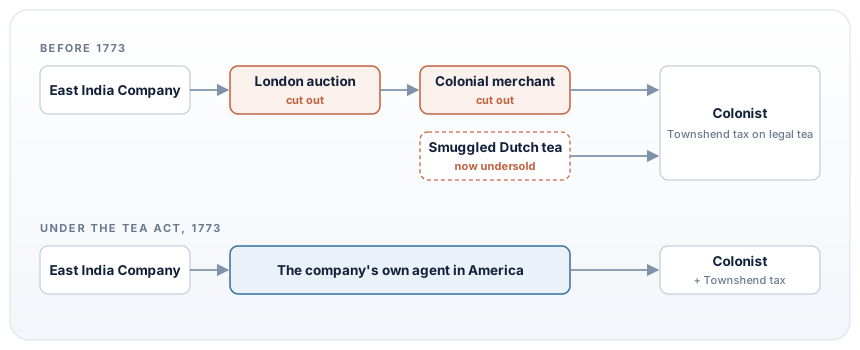
The Tea Act shortened the route. The tax stayed on it.
Why cheap tea was a trap
This is where “no taxation without representation” stops being a slogan. The colonies elected no one to Parliament in London. Their own assemblies could tax them; Parliament, the colonists argued, could not. Every pound of cheap tea a colonist bought would carry the three-pence tax, and with it a quiet admission that Parliament could tax them after all, to pay officials who answered to London.
The lower price was the bait. Paying the tax was the hook.
Who else stood to lose
Principle was not the only thing at stake. The new route cut out colonial merchants who had bought at the London auction and resold, and they reacted with anger. It undercut the smugglers too. The Act, says the American Battlefield Trust, put “many tea smugglers and legitimate importers out of business.” The protest had a constitutional argument at its heart, and backers with money riding on tea staying expensive.
On the night of 16 December 1773, men boarded three ships in Boston Harbor and dumped 342 chests of company tea into the water. The tea was cheaper than before. That was the problem.
I had always pictured the Tea Party as a revolt against tea made expensive by a tax. It was a revolt against tea made cheap by a bailout, with the tax tucked inside. The real price of that cheaper tea was a tax no one in Boston had voted for.
Sources
- UK Parliament, Parliament and the East India Company: the 1772 crisis and the 1773 loan.
- Britannica, Tea Act: the unsold tea and the act’s design.
- American Battlefield Trust: the Townshend Act text (three pence per pound), why the revenue paid governors and judges, and the Boston Tea Party.
- HISTORY, Tea Act: smuggled tea, principled refusal, and the merchants’ reaction.
Every Wednesday I pull a thread from my second brain and chase a new idea, usually where two fields meet. It is my quest to understand a bit more, and wire up a new synapse. Read the rest of the series, or follow the 60-second versions at @vinavu_ai.