
Midweek Synapse #10
Start a company in the United States and you have to pick a legal form. Business textbooks warn that one of them, the C corporation, is the expensive choice, because its profits get taxed twice.
Yet nearly every startup that raises venture capital picks exactly that form, usually registered in Delaware. These companies have some of the best-paid lawyers and accountants in the economy, and they all choose the option the textbook flags as costly.
The reason surprised me. Follow the money behind a startup far enough and you often reach a university. Universities invest part of their endowments in venture funds, and venture funds invest in startups. That university, two steps away, turns out to be a big part of why the startup is a C corporation.
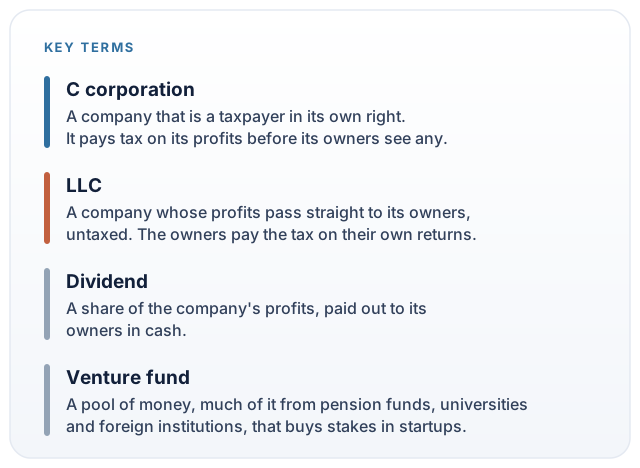
First, four terms that the rest of this depends on.
“Taxed twice” mostly never happens
The second tax has a trigger, and the trigger is a dividend. A company pays tax on its profit, then hands what is left to its owners, and the owners pay tax on it again.
A startup almost never pulls that trigger. It loses money for years, so there is no profit to tax. When it does make money, it reinvests. And its owners get paid by selling their shares when the company is bought or goes public, which is taxed once, as a gain on the sale.
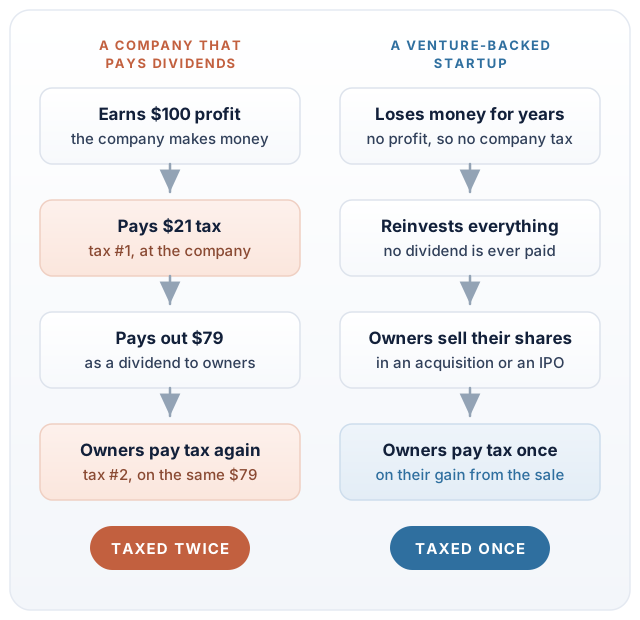
The $21 is the US federal corporate rate of 21 percent. The textbook’s warning is real for the company on the left. It rarely applies to the one on the right.
There is one exception worth knowing. If a buyer purchases the company’s assets instead of its shares, the double tax comes back at the very end. That is one reason startup acquisitions are usually structured as a purchase of shares.
Three things only a C corporation can offer
So the famous downside barely applies. Meanwhile, a C corporation can do three things that no other legal form can.
1. A tax break when the owners sell. A US rule known as QSBS, short for Qualified Small Business Stock, lets people who got their shares directly from a small C corporation, and held them for years, skip tax on part or all of their gain when they sell. The limits are real. The break is capped per company at $10 million or $15 million depending on when the shares were issued, or ten times what you paid if that is more. The holding period runs three to five years. And many kinds of business, including law, health, consulting and finance, do not qualify at all (the statute). But only a C corporation can offer it at all.
2. It protects the university at the top of the chain. This is the one that has nothing to do with the startup’s own taxes.
Here is the chain of money behind a typical startup. A university puts part of its endowment into a venture fund. So do pension funds, foundations and foreign institutions (NVCA). The venture fund then buys a stake in the startup.
A university is a nonprofit, and it generally does not pay income tax on what its investments earn. Profits from running a business are the exception: those it has to pay tax on. A foreign institution, for its part, normally never has to file a US tax return. Both want to keep it that way.
Now suppose the startup is an LLC. Its profits are not taxed at the company. They pass up to its owners, which includes the venture fund. The fund is also a pass-through, so the profits keep going, up to the university. The university now has business income, and a tax bill it joined the fund to avoid. The foreign institution now has to file a US return.
A C corporation stops this at the bottom. It pays its own tax, and nothing passes up the chain to the university.
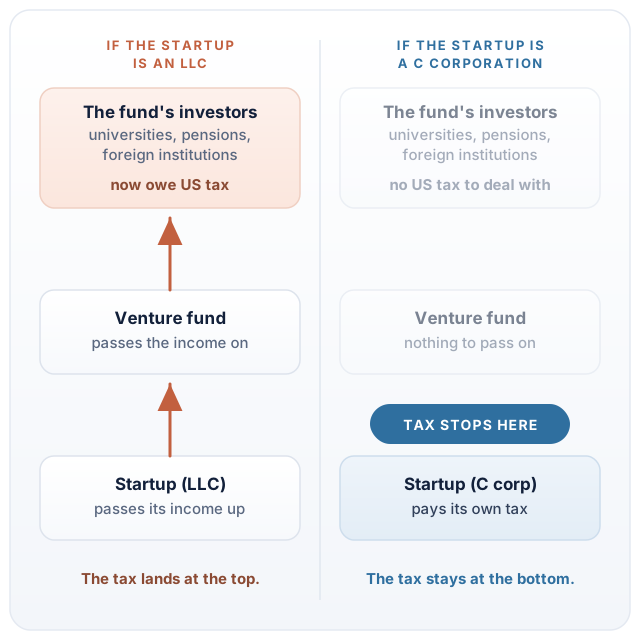
Same startup, same fund, same investors. Only the legal form at the bottom changes, and it decides who ends up with the tax bill.
Fund agreements commonly promise their tax-exempt investors to avoid this kind of income (Morgan Lewis, a law firm guide for fund lawyers). So the fund asks the startup to be a C corporation, ideally from day one.
That is how a two-person startup ends up choosing its legal form to suit a university it has never dealt with.
3. Real shares of stock. Venture deals run on shares. Investors buy preferred shares, which come with extra rights such as being paid back first if the company is sold. Employees get stock options, and the tax-favoured kind can only be granted by a corporation (the rule). An LLC has “membership interests” instead of shares, which fit none of this neatly.
What about the S corporation, the other form that avoids double tax? It is allowed only one class of shares, which rules out preferred shares, and a venture fund is not allowed to own it (the statute).
Why Delaware, then?
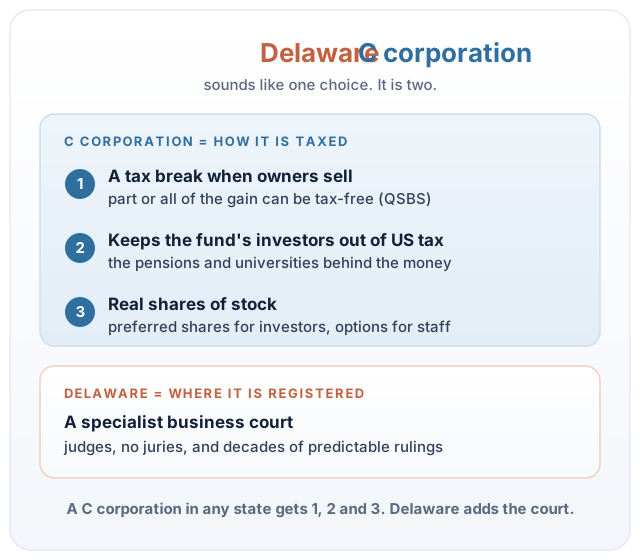
“Delaware C corporation” is two choices bundled together. Everything above comes from being a C corporation, and a C corporation registered in Nevada or Wyoming would get all of it.
Delaware adds a court. Its Court of Chancery hears business disputes before judges rather than juries (Delaware Courts), and it has a long record of rulings, so investors can predict how a dispute will go.
Some large public companies have left Delaware since 2024, mostly for Nevada. It is fewer than the headlines suggested: 18 of the 28 reincorporation proposals at US public companies in 2025 were moves out of Delaware (Glass Lewis), a small fraction of the companies registered there (Harvard Law School Forum). Young startups still default to Delaware.
The $500,000 mistake
The real cost of all this is usually getting the structure wrong.
In a 2014 Stanford lecture, Y Combinator’s general counsel, Carolynn Levy, told the story of a company that started as an LLC and later tried to convert into a Delaware corporation. The paperwork was done wrong. For a couple of years the company believed it was a Delaware corporation when legally it was still an LLC. The mistake surfaced in the middle of a big fundraise. Untangling it took four law firms, and the bill had reached $500,000 and was still climbing.
Nobody in that story paid double tax. What cost them was having the wrong structure when the investors arrived.
The takeaway
The textbook is right about companies that earn steady profits and pay dividends. A startup is a different kind of company: it gets paid by selling shares, its money comes from universities and other institutions with tax rules of their own, and its deals run on shares of stock.
So a startup’s legal form is decided less by what the startup does than by who stands behind the money, a university among them.
Everything here is US federal tax law, and it explains why the system works this way. It is not advice on how to set up your own company. Talk to a lawyer and an accountant for that.
Sources
- 26 U.S.C. §1202, Qualified Small Business Stock, as amended in 2025.
- 26 U.S.C. §1361, S corporation rules.
- Treas. Reg. §1.421-1, which entities can grant incentive stock options.
- Morgan Lewis, VC/PE Funds Deskbook: Accommodating Tax-Exempt Investors.
- National Venture Capital Association, What is Venture Capital?
- Delaware Courts, Court of Chancery.
- Glass Lewis, State of US Reincorporation 2025.
- A&O Shearman, “Is ‘DExit’ Real?”, Harvard Law School Forum on Corporate Governance, January 2026.
- Carolynn Levy and Kirsty Nathoo, “Legal and Accounting Basics for Startups,” Stanford CS183B, Lecture 18 (2014). Transcript.
Every Wednesday I pull a thread from my second brain and chase a new idea, usually where two fields meet. It is my quest to understand a bit more, and wire up a new synapse. Read the rest of the series, or follow the 60-second versions at @vinavu_ai.