
Midweek Synapse #6
Economics, entrepreneurship, and marketing each have their own theory of disruption, and none of the three mean the same thing by it. Worse: a widely used entrepreneurship textbook uses the word for a company, and the economist who defined the term says flatly that the textbook is wrong.
That economist is Clayton Christensen, and the company is Uber.
Three theories, one word
Schumpeter’s creative destruction (1942) is the oldest and the loosest: an economy-wide “perennial gale,” new firms and methods sweeping away old ones, over and over, forever. It says nothing about mechanism, just that the churn is constant and, on balance, worth it.
Christensen’s disruptive innovation (1995, elaborated in The Innovator’s Dilemma, 1997) is the narrow one, and the one everyone borrows the word from without borrowing the definition. A disruptive innovation starts inferior, on the metrics incumbents care about, and gets its foothold either at the cheap low end (customers the market already overserves) or in a new market entirely (people who couldn’t previously afford or access the category at all). Incumbents, chasing better margins, retreat upmarket and cede the ground, and the entrant climbs up to replace them later. That sequence, low or new, then up, is the whole theory.
Marketing’s discontinuous innovation, from Everett Rogers’ diffusion tradition, measures something else again: how much the consumer’s behavior has to change to use the thing at all. The smartphone is the standard example, because it made people relearn how they use a phone.
The smartphone is also the cleanest proof these aren’t three names for one idea. It’s Marketing-discontinuous (real behavior change) but Christensen-sustaining (it was a better, more expensive product aimed at existing high-end phone buyers, not a cheap low-end sneak-in). Same object. Opposite verdict, depending which theory you’re using.
The Uber problem
OpenStax’s Entrepreneurship textbook lists Uber and Lyft as built on “disruptive technology.” Christensen, writing with Raynor and McDonald in a 2015 Harvard Business Review piece written specifically to correct loose uses of his own term, names Uber as the flagship counter-example. It launched in San Francisco, a well-served taxi market, aimed at people already in the habit of hiring rides. No low end, no new market. By his own definition, Uber disrupted the taxi industry without being a disruptive innovation.
Both statements can’t be right, and it’s revealing which one loses: the theorist beats the textbook. “Disruptive” had already drifted into meaning “successful and disliked by incumbents” well before it reached that table.
So is the frontier LLM disruptive?
Run the three theories against ChatGPT-class models and you get a split decision, and it’s the same split the smartphone gave.
- Schumpeter: yes. An economy-wide gale remaking many industries at once is exactly what a frontier model wave looks like.
- Christensen: no. The frontier model entered at the expensive, state-of-the-art top, adopted first by knowledge workers, not at the cheap bottom aimed at overserved or priced-out customers. That’s the reverse of a low-end foothold, which makes “AI is disruptive” precisely the sloppy usage his 2015 paper exists to correct.
- Marketing: yes. It demands real behavior change and its spread runs into the same adoption-curve dynamics as any category-defining product.
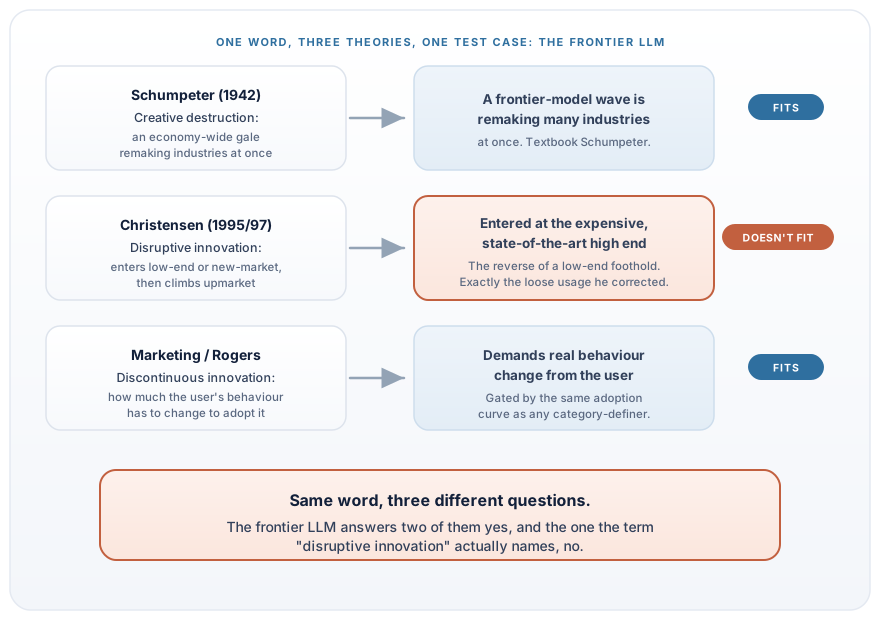
Same word, three different questions, and the LLM doesn’t answer them the same way.
There’s a real wrinkle inside that “no.” Cheap, open-weight models undercutting the frontier on price are a genuine low-end foothold. AI tools reaching people who never had access to a lawyer, a tutor, or an analyst are a genuine new-market foothold. Christensen’s theory hasn’t failed everywhere in AI, just for the frontier-model story specifically. “Is AI disruptive” doesn’t have one answer, because “AI” isn’t one innovation.
The word wasn’t even Schumpeter’s
One more correction, smaller but worth keeping. Schumpeter is usually credited with coining “creative destruction.” He didn’t. The term entered economics through Werner Sombart, who was drawing on Nietzsche; Schumpeter popularized it in Capitalism, Socialism and Democracy (1942) rather than originating it. It’s the same shape of error as the Uber one: a phrase gets attached to its most famous user rather than its first one, and the attached-to name is the one that ends up in the textbook.
Which is really the whole post in miniature. “Disruptive” gets used as if it’s a single, settled judgment, when it’s actually three different, checkable claims, and picking the wrong one means forecasting the wrong winner.
Sources
- Christensen, Raynor & McDonald, “What Is Disruptive Innovation?”, Harvard Business Review, Dec 2015, the piece naming Uber as the theory’s flagship non-fitting case.
- Reinert & Reinert, “Creative Destruction in Economics: Nietzsche, Sombart, Schumpeter”, on the term’s actual origin before Schumpeter.
Part of #MidweekSynapse, my weekly quest to learn in public.
Every Wednesday I pull a thread from my second brain and chase a new idea, usually where two fields meet. It is my quest to understand a bit more, and wire up a new synapse. Read the rest of the series, or follow the 60-second versions at @vinavu_ai.