Midweek Synapse #21
Here is a complete love poem, about two thousand years old:
யாயும் ஞாயும் யார் ஆகியரோ?
எந்தையும் நுந்தையும் எம் முறைக் கேளிர்?
யானும் நீயும் எவ் வழி அறிதும்?
செம் புலப் பெயல் நீர் போல
அன்புடை நெஞ்சம் தாம் கலந்தனவே.What is my mother to yours?
How is my father kin to yours?
By what road did you and I ever meet?
Like rain on red earth,
our loving hearts have run into one.
That is all of it. It is poem 40 of the Kuruntokai (குறுந்தொகை), and the name of the collection gives the game away: kuru means short, tokai means collection. The old editors sorted Tamil love poems into collections by length. The Kuruntokai took the short ones, four to eight lines each. Its companion, the Akananuru (அகநானூறு), also called the Nedunthokai (நெடுந்தொகை) or “long collection”, took poems of thirteen to thirty-one lines. A third collection, the Purananuru (புறநானூறு), held 400 poems of four to forty lines on war, kings, and public life. Tamil poets split their world in two: akam (அகம்), the inner life of love, and puram (புறம்), the outer life of the court and the battlefield. This post is about the inner side, where short was a chosen form, not an accident.
So how does five lines carry a love story? The poem names no one, describes no place, and gives no time. Even its poet is unknown. Tradition calls him Cempulappeyanirar (செம்புலப் பெயனீரார்), “the poet of rain on red earth”, after the simile in line four.
The grammar holds the scenery
The answer is the Tolkappiyam (தொல்காப்பியம்), one of the oldest surviving grammars in the world. It is considered to have been compiled in layers from around the turn of the common era to about the fifth century. Its third book is about poetry, and it is strict.
In the main kinds of love poem, it says, no one may be named (Akattinaiyiyal, அகத்திணையியல், rule or nurpa (நூற்பா) 54). Instead, the grammar ties love to land. It names five landscapes, each called a tinai (திணை), and gives each one a single stage of love. The hills stand for lovers who meet. The forest stands for a wife who waits for her husband. The farmland stands for a wife who sulks over his affairs. The seashore stands for pining. Each landscape also comes with its own season, hour, god, birds, and flowers. So when a poet names a hill flower, the listener already knows the mood.
Poem 40 is filed under kurinji (குறிஞ்சி), the hills. For a trained listener, that one label opens the whole scene: a hillside at midnight, in the cold season (rule 6), and two lovers who meet in secret before their families know. That is why the man asks what his mother is to hers. The poem does not need to say any of it. The grammar already did.
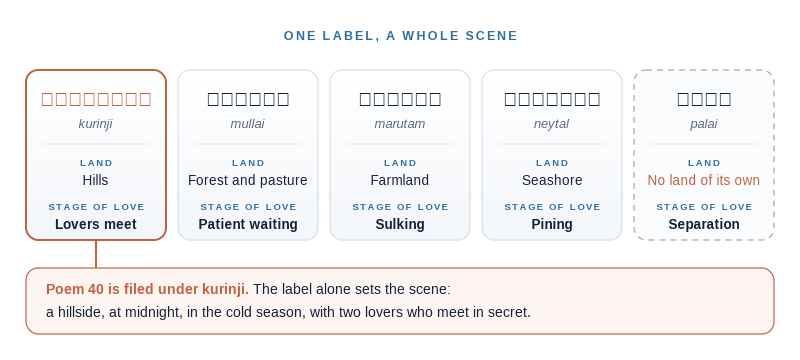
Name the landscape and you have named the mood. Palai, separation, is the one tinai the grammar gives no land.
A word by the company it keeps
In 1957 the linguist J. R. Firth wrote, “You shall know a word by the company it keeps.” The meaning of a word, in this view, comes from the words around it. Word embeddings, the first layer of every modern language model, learn exactly that.
The Tolkappiyam applied the same rule to feeling. You know an emotion by the land, the hour, and the season around it. The two ideas have no historical link, but they share one structure: meaning lives in context. Give the reader the context, and five lines are enough.
One mood in the grammar gets no land at all: separation. And a later Tamil classic, the Thirukkural (திருக்குறள்), went shorter still: 1,330 couplets of two lines each, in a strict metre. Both stories are for another week.
Sources: the Tolkappiyam, Akattinaiyiyal, Naccinarkkiniyar’s edition and numbering (Project Madurai); Kuruntokai 40 (Tamil Wiki), translation mine; the anthologies’ line ranges (Wikipedia, Akananuru, Purananuru); Firth via Quote Investigator.
Every Wednesday I pull a thread from my second brain and chase a new idea, usually where two fields meet. It is my quest to understand a bit more, and wire up a new synapse. Read the rest of the series, or follow the 60-second versions at @vinavu_ai.