
Midweek Synapse #8
In January 1970, the first published radiometric age for lunar material came out at 4.66 billion years.
The solar system is 4.567 billion years old.
Nothing in it can be older than that, so the number was impossible on its face. And yet the measurement was careful, the method was sound, and no one had made an arithmetic error. Getting to why takes you through the physics that dates a moon rock, which turns out to be the same physics that dates a mammoth bone.
One law, clocks that differ by a factor of two hundred thousand
Radiocarbon dating and radiometric dating get talked about as cousins. They are closer than that. They are one measurement run twice.
A radioactive isotope decays into a daughter product at a fixed, statistically predictable rate, its half-life, and that rate does not care about temperature, pressure, or what chemistry the atom is caught up in. Measure how much parent is left against how much daughter has piled up, and the elapsed time falls out of the decay equation. That is the whole idea, and it is the same idea whether the sample is basalt or bone.
What separates the two fields is which isotope pair they pick, because the half-life has to match the timescale you are trying to measure.
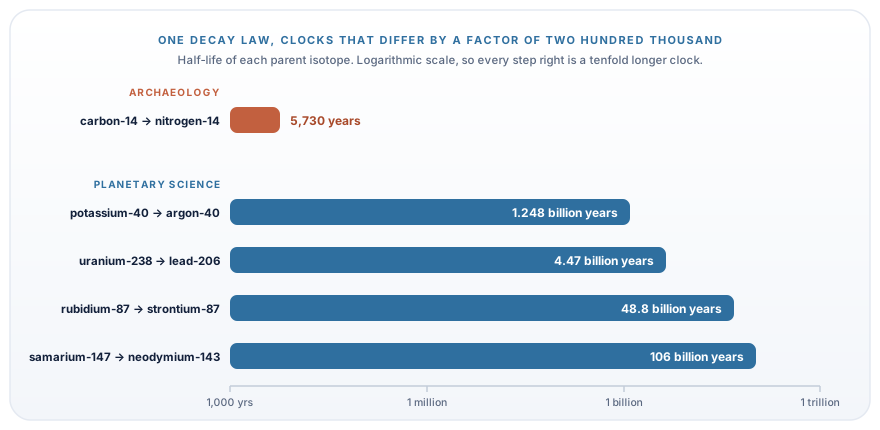
The scale is logarithmic, so the gap between archaeology’s clock and the slowest of planetary science’s is wider than it looks.
Archaeology runs on carbon-14 decaying to nitrogen-14, half-life 5,730 years, which the National Park Service puts to work over an effective range of about 100 to 50,000 years. Past that there is too little carbon-14 left in the sample to measure.
Planetary science needs clocks that are still ticking after four and a half billion years, so it reaches for pairs like uranium-238 to lead-206 at 4.47 billion years, or samarium-147 to neodymium-143 at 106 billion. A rock that old has to still contain a measurable amount of parent isotope, or there is nothing to weigh the daughter against.
Same equation. Different gear ratio.
Two answers from one landing site
Apollo 11 came back in July 1969 with the first material anyone had ever been able to point an isotope lab at. Before that, lunar chronology was entirely relative. You could count craters on two patches of surface and say which had been sitting there longer, but you could not attach a year to either.
The first ages were published within about six months, by two different groups using two different isotope systems. They did not agree.
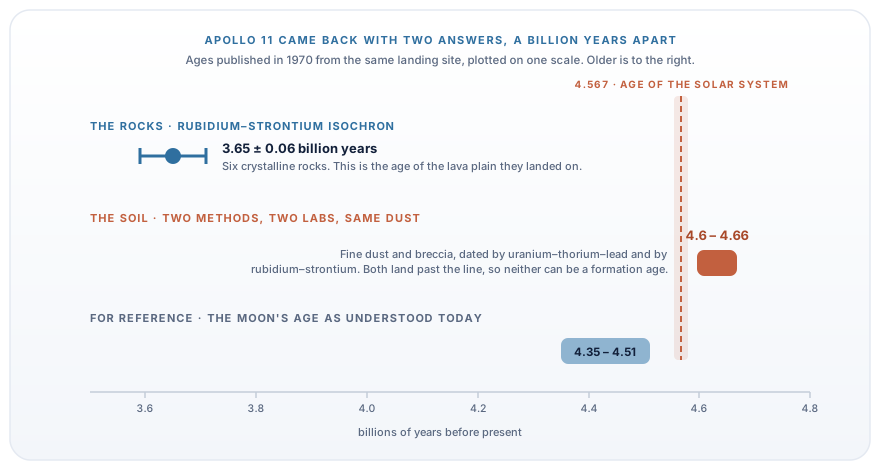
Same landing site, same year of publication, a billion years between the answers.
Mitsunobu Tatsumoto and John Rosholt of the US Geological Survey ran uranium-thorium-lead on the fine dust and breccia and published a concordant age of 4.66 billion years in Science on 30 January 1970. Concordant is the strong word here. Several independent isotope ratios in that system agreed with each other, which is exactly the internal consistency check that normally tells you a date is trustworthy.
Papanastassiou, Wasserburg and Burnett ran rubidium-strontium on six crystalline rocks from the same site and got 3.65 billion years, give or take 60 million. Tight cluster, six samples. Also trustworthy. They then ran the same method on the soil and got roughly 4.6 billion, agreeing with the USGS result on the dust while disagreeing with their own result on the rocks.
So the dust was a billion years older than the ground it was sitting on, and two labs using unrelated isotope systems independently agreed on the impossible number.
Why the dust is older than the ground
The resolution is that the soil ages are model ages, and a model age on lunar regolith is not measuring what a first reading suggests.
The Moon has no atmosphere and no weather, so its surface is worked over by impacts instead. Everything that hits it throws material outward, and over billions of years that churn spreads debris across the whole body. The dust sitting on Mare Tranquillitatis is a blend, carrying fragments from terrain far older than the lava plain the astronauts were standing on.
Date that blend and you get an average over its ingredients, weighted in a way nobody chose. It is a real number, and it corresponds to no real event.
The rocks, meanwhile, were doing the honest thing. A crystalline rock’s isotope clock resets when it solidifies, so 3.65 billion years is when that lava froze. That figure has held up. The mare basalts are dated today to roughly 3.3 to 3.8 billion years.
And the impossible number turned out to be the most useful thing in the data. Its excess over anything the landing site could produce was direct evidence that older crust existed somewhere else on the Moon, before anyone had been to the highlands to sample it. Later missions found exactly that, with the oldest highland rocks near 4.4 billion years.
The modern age of the Moon sits between 4.35 and 4.51 billion years, depending on whether you date whole rocks or individual zircon grains. Not 4.66. Nothing is.
The one pair that does not behave
While checking the isotope figures for this piece I found a wrinkle that undercuts the tidy version of the story I had been telling myself, so it belongs here.
Potassium-argon dating is the workhorse for volcanic rock and for the ash layers that bracket hominin fossils. Described the usual way, potassium-40 decays to argon-40 with a half-life of about 1.25 billion years, and you measure the two.
Except potassium-40 does not only decay to argon-40. About 89% of it beta-decays to calcium-40, and only about 11% takes the electron-capture route to argon. The isotope whose half-life the method quotes is mostly not turning into the daughter the method measures. Potassium-argon dating works by carrying the branching ratio alongside the half-life, and the partial half-life for the argon branch on its own is closer to 11.9 billion years.
That does not break anything. It does mean “measure the parent, measure the daughter, read off the time” is a summary rather than a description, and the one pair most likely to show up in an archaeology paper is the pair where the summary is loosest.
One number in that paragraph is worth pinning down, because textbooks disagree on it. Potassium-40’s half-life is often printed as 1.31 billion years. The current value is 1.248 billion. Those are not two roundings of one constant, they differ by about 5%, and the higher figure is simply an older measurement that some editions still carry.
The same trick, on a mammoth bone
Radiocarbon got there first. Willard Libby worked the method out in 1946 at the University of Chicago, and in December 1949 he and James Arnold published what they called the Curve of Knowns: they dated objects whose true ages were already established and showed the radiocarbon results landing where they should. Proving a method against known answers, rather than asserting it, is what made archaeologists believe it. Libby took the 1960 Nobel Prize in Chemistry for it.
What it replaced was a discipline that could say older-than and younger-than and nothing else. Typology and stratigraphy sequence things beautifully and date nothing absolutely. Radiocarbon attached years, and it did so on the same decay law that would put a number on the Moon two decades later.
Absolute dates are also what let you test a story against a physical event, which is the machinery underneath an earlier installment here on oral traditions that turn out to encode real geology. Without a year attached to the eruption, the tradition is just a good story.
The two methods still cannot be swapped. Carbon-14 dies out past 50,000 years. The billion-year pairs cannot resolve anything younger than millions of years, because too little daughter has built up to measure against the parent. Archaeology also carries a calibration problem astronomy does not, since atmospheric carbon-14 has drifted over time and has to be corrected against tree-ring records, while nuclear testing after 1950 distorts anything recent.
What I am not claiming
I cannot tell you that the 1970 teams understood the soil ages the way I have described them here. They flagged the discrepancy and were careful about the word model, but reading a fifty-six-year-old result with the answer already in hand is not the same as sitting in that lab in 1970.
I also want to be accurate about what went wrong, which is nothing. No instrument misread, no one fumbled a decay constant. Two groups measured carefully, published honestly, and produced a number that could not be true as a formation age. The error was in what a reader would naturally take the number to mean.
That is the part I keep turning over. The strongest signal in the Apollo 11 data was not the measurement that was right. It was the measurement that was impossible, sitting next to a correct one, refusing to be reconciled. Last time it was a number that companies openly call an estimate doing billions of dollars of work. This time it is a number that was never wrong, only misread, and pointed at ground nobody had walked on yet.
Sources
- Tatsumoto, M. and Rosholt, J. N., “Age of the Moon: An Isotopic Study of Uranium-Thorium-Lead Systematics of Lunar Samples,” Science 167(3918), 461-463, 30 January 1970, for the concordant 4.66 billion year result on dust and breccia. This is a USGS paper, and it is often miscited to the Caltech group below.
- Papanastassiou, D. A., Wasserburg, G. J. and Burnett, D. S., “Rb-Sr ages of lunar rocks from the Sea of Tranquillity,” Earth and Planetary Science Letters 8, 1-19, 1970, for the 3.65 billion year isochron on six crystalline rocks and the roughly 4.6 billion year model age on the soil.
- Radiometric Age Dating, US National Park Service, for the half-life table and carbon-14’s 100 to 50,000 year effective range.
- Dating Artifacts, Smithsonian Museum Conservation Institute, independently confirming carbon-14’s 5,730 year half-life and 50,000 year ceiling.
- Bouvier, A. and Wadhwa, M., “The age of the Solar System redefined by the oldest Pb-Pb age of a meteoritic inclusion,” Nature Geoscience, 2010, for the 4.567 billion year figure that makes 4.66 impossible.
- Barboni, M. et al., “Early formation of the Moon 4.51 billion years ago,” Science Advances, 2017, for the modern lunar age.
- Willard Libby and Radiocarbon Dating, American Chemical Society National Historic Chemical Landmark, for the 1946 method, the 1949 Curve of Knowns with James Arnold, and the 1960 Nobel.
Part of #MidweekSynapse, my weekly quest to learn in public.
Every Wednesday I pull a thread from my second brain and chase a new idea, usually where two fields meet. It is my quest to understand a bit more, and wire up a new synapse. Read the rest of the series, or follow the 60-second versions at @vinavu_ai.