
Midweek Synapse #2
Two of the fields I read most both turn on a single word: culture. Anthropology is built on it. Marketing cannot function without it. So this week I ran a simple experiment. I put an anthropology textbook and a marketing textbook side by side and asked whether they actually mean the same thing when they say it.
They almost do. The “almost” is the whole story.
The map transfers
Both fields define culture in nearly the same words: something learned, shared, and mostly invisible. Marketing then goes a step further and borrows anthropology’s actual teaching tools.
The main one is the culture iceberg. The idea is that a culture works like an iceberg. The part above the water, the food and dress and language and festivals, is the small visible tip. The far larger part below the surface, the beliefs and assumptions and unspoken rules about fairness, time, and status, sits out of sight and does most of the steering, often invisibly even to the people inside it.

The model, in the wild. The crown above the water is the small part; the mass doing the work is under it. AWeith, Wikimedia Commons, CC BY-SA 4.0.
That image is credited to Edward T. Hall, a cultural anthropologist, and his 1976 book Beyond Culture. The marketing textbook even names him on the slide: “Anthropologist Edward T. Hall.” The credit is a little too tidy, as it turns out. Hall actually wrote about culture in overt and covert layers and once called the iceberg analogy inadequate; the clean picture we use now was hardened into shape by the intercultural trainers who came after him. Which is already the pattern of this whole piece: a careful idea shedding its caveats as it travels.
So the diagram transfers cleanly. What does not transfer is the reason anthropology drew it.
The compass does not
In anthropology, the iceberg comes attached to a rule: cultural relativism. It is not the “anything goes” caricature. It is a working method. Understand a practice on its own terms before you judge it, and watch for your own bias first, because you absorbed it without ever noticing.
Marketing keeps the iceberg and drops the rule. It studies the hidden mass in order to act on it, faster and more persuasively. Understanding is not the goal; a purchase is.
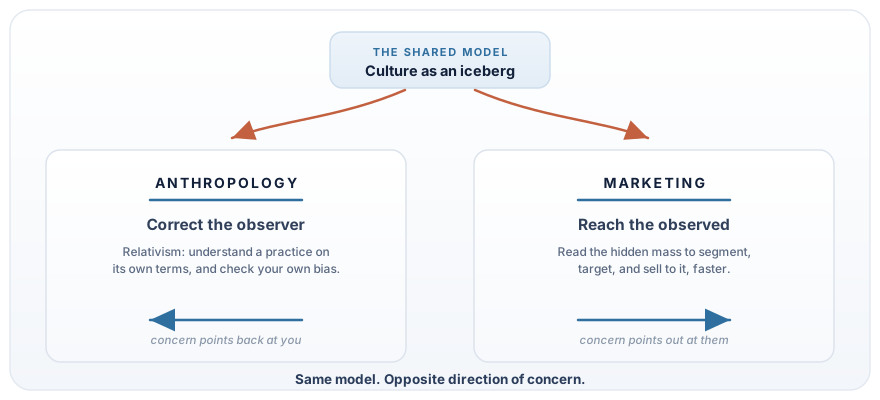
Same model, two directions. Anthropology turns the concept back on the observer; marketing turns it outward, toward the customer.
You can watch a single shared word bend as it crosses that border. Take ethnocentrism, judging another culture by the standards of your own. It means the same thing in both fields, but its job flips. In anthropology it is a flaw to root out of the researcher. In marketing it is a risk to manage in the campaign, so you do not ship something like Burger King’s “Texican Whopper,” a 2009 ad that mashed a US and a Mexican stereotype together and had to be pulled after Mexico complained.
Same word, opposite direction of concern. Anthropology’s idea of culture exists to correct the observer. Marketing’s exists to reach the observed.
What quietly falls away
Neither textbook is wrong. A marketing chapter is under no obligation to make you re-examine yourself. This is not a contradiction to settle, but a difference in purpose that the shared vocabulary hides.
Still, it is worth noticing what falls away when a concept moves from a field that built it for reflection to one that needs it for action. The tool arrives intact. The discipline that made it safe to hold stays behind.
If you like watching an idea get checked against an outside standard, that was also the move in an earlier Synapse on geomythology, where the standard was tree rings and tsunami records instead of a second textbook.
Sources
- Hall’s iceberg model, from Beyond Culture (1976), hosted by Lewis & Clark College.
- Cultural relativism as a research stance, not a moral one: OpenStax, Introduction to Anthropology, section 1.6.
- The iceberg and Hofstede put to work in a marketing chapter, including the “Anthropologist Edward T. Hall” attribution: OpenStax, Principles of Marketing, section 8.3.
Part of #MidweekSynapse, my weekly quest to learn in public.
Every Wednesday I pull a thread from my second brain and chase a new idea, usually where two fields meet. It is my quest to understand a bit more, and wire up a new synapse. Read the rest of the series, or follow the 60-second versions at @vinavu_ai.