Midweek Synapse #4
Here’s a problem I hadn’t thought about until this week. If you wanted to check how life on Earth actually began, you couldn’t. Not directly.
The chemistry that became life happened somewhere around four billion years ago. Plate tectonics has since recycled almost every rock older than about 3.8 billion years, subducted and melted and re-formed. The oldest rock we have is the Acasta Gneiss at roughly 4.03 billion years, and it’s a fragment. The window where it happened is a window we can’t read anymore. Earth kept the outcome and destroyed the evidence.
That’s the setup for the best story I’ve read all month.
A prediction with nothing to point at
In 1993, a geochemist named Michael Russell proposed that life started at alkaline hydrothermal vents on the seafloor. Not the scalding black smokers everyone knew about, but something gentler: places where seawater reacts with mantle rock, and the rock gives off hydrogen. Get hydrogen meeting carbon dioxide across a mineral membrane and you have a natural proton gradient, which is, more or less, how every living cell on Earth still makes its energy today.
The awkward part: no vent like that had ever been found. He was describing a place that existed only in theory.
Seven years later, in 2000, a research cruise in the mid-Atlantic found one. White carbonate chimneys, up to sixty metres tall, warm and alkaline and venting hydrogen. They called it the Lost City. It was, roughly, what Russell said would be there.
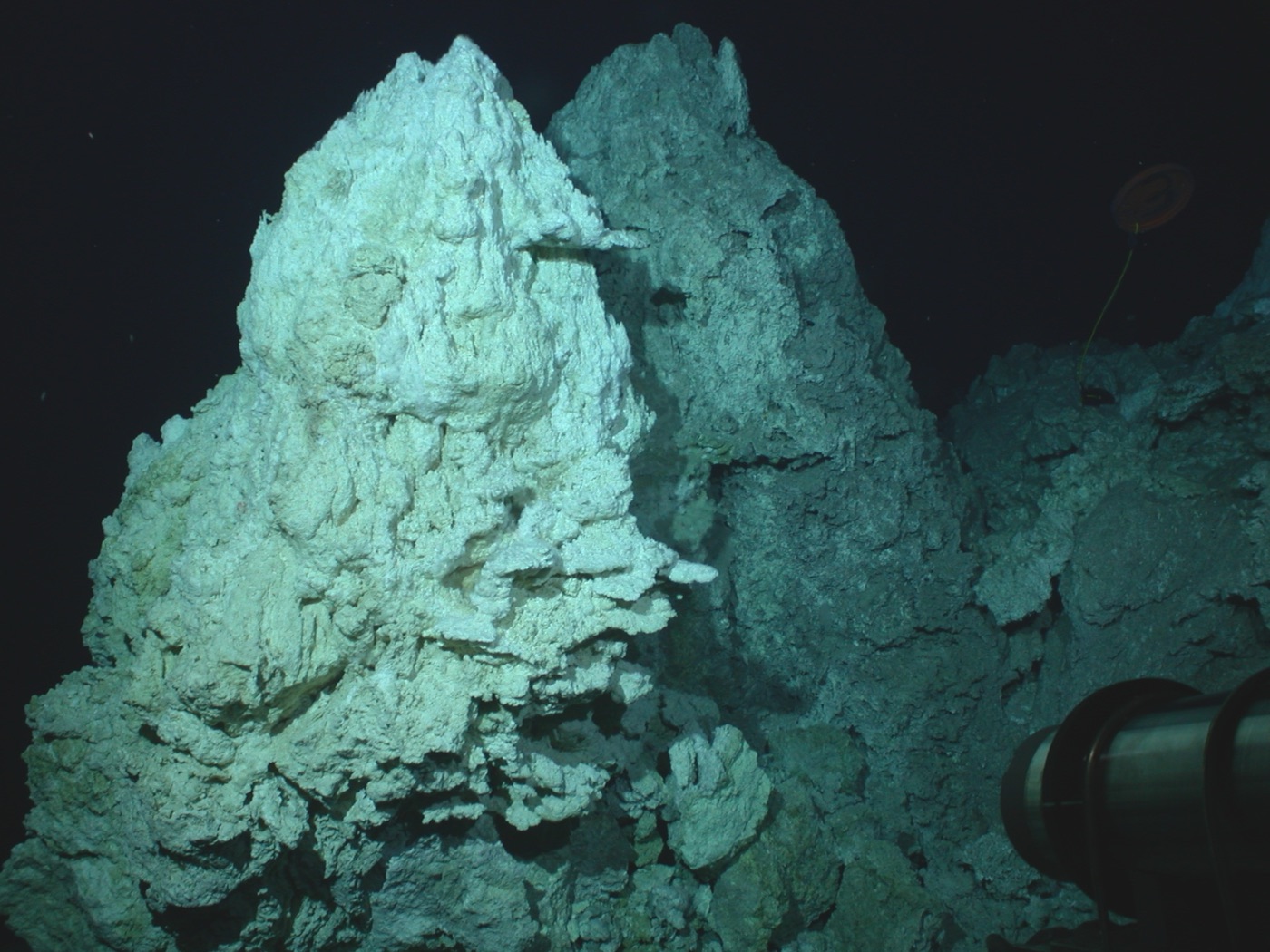
The Lost City vent field: the place Russell described before anyone had seen it. NOAA (public domain).
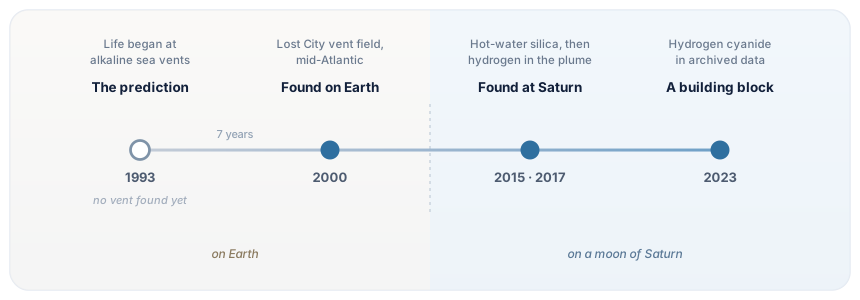
A prediction, then two confirmations. The second one wasn’t on this planet.
The part that isn’t on Earth
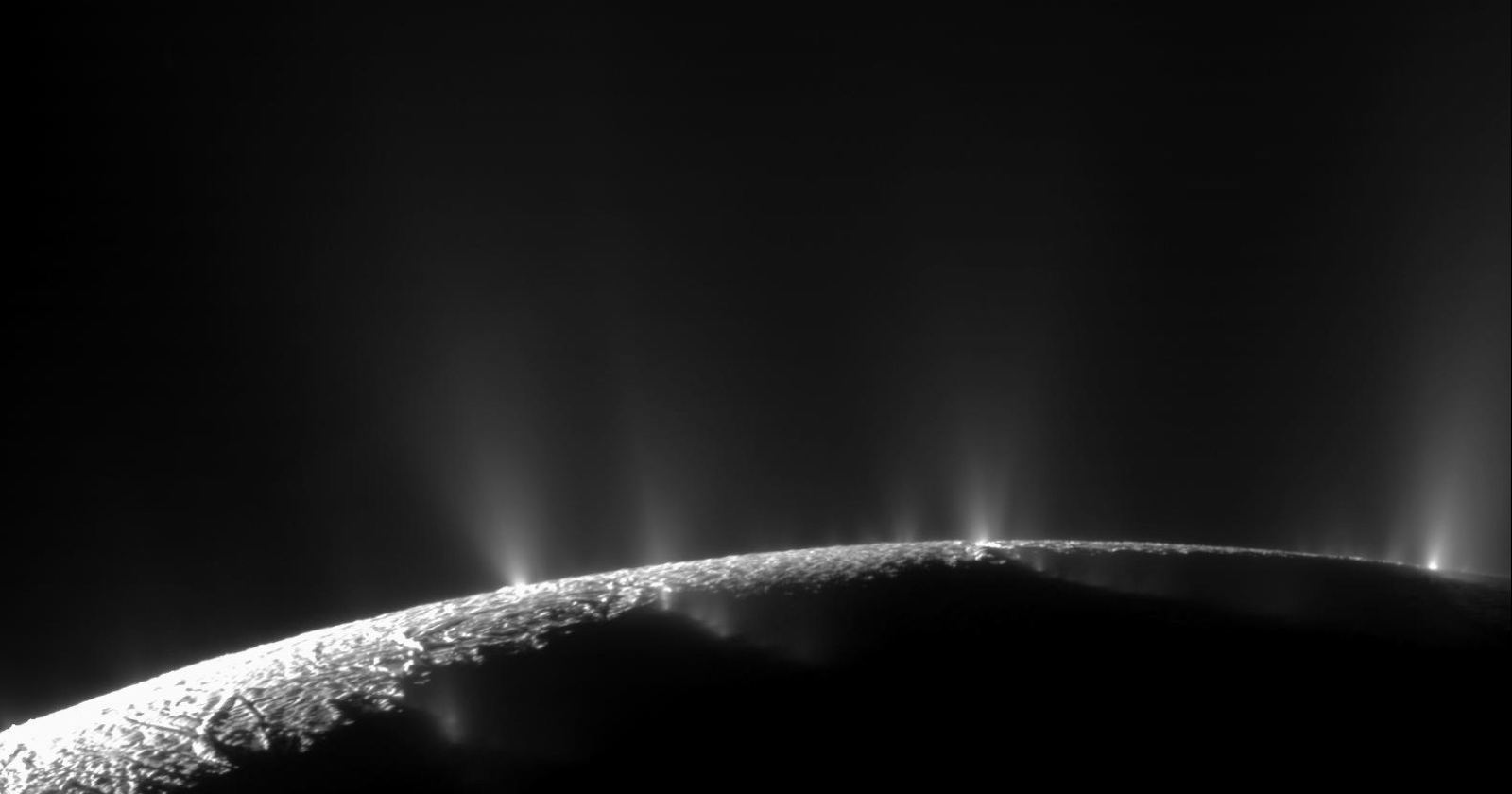
Enceladus is a small moon of Saturn, about 500 kilometres across, covered in ice. In 2005 the Cassini spacecraft photographed something remarkable at its south pole: geysers, erupting through fractures in the ice, throwing water hundreds of kilometres into space. There’s a liquid ocean under that shell, and it leaks.
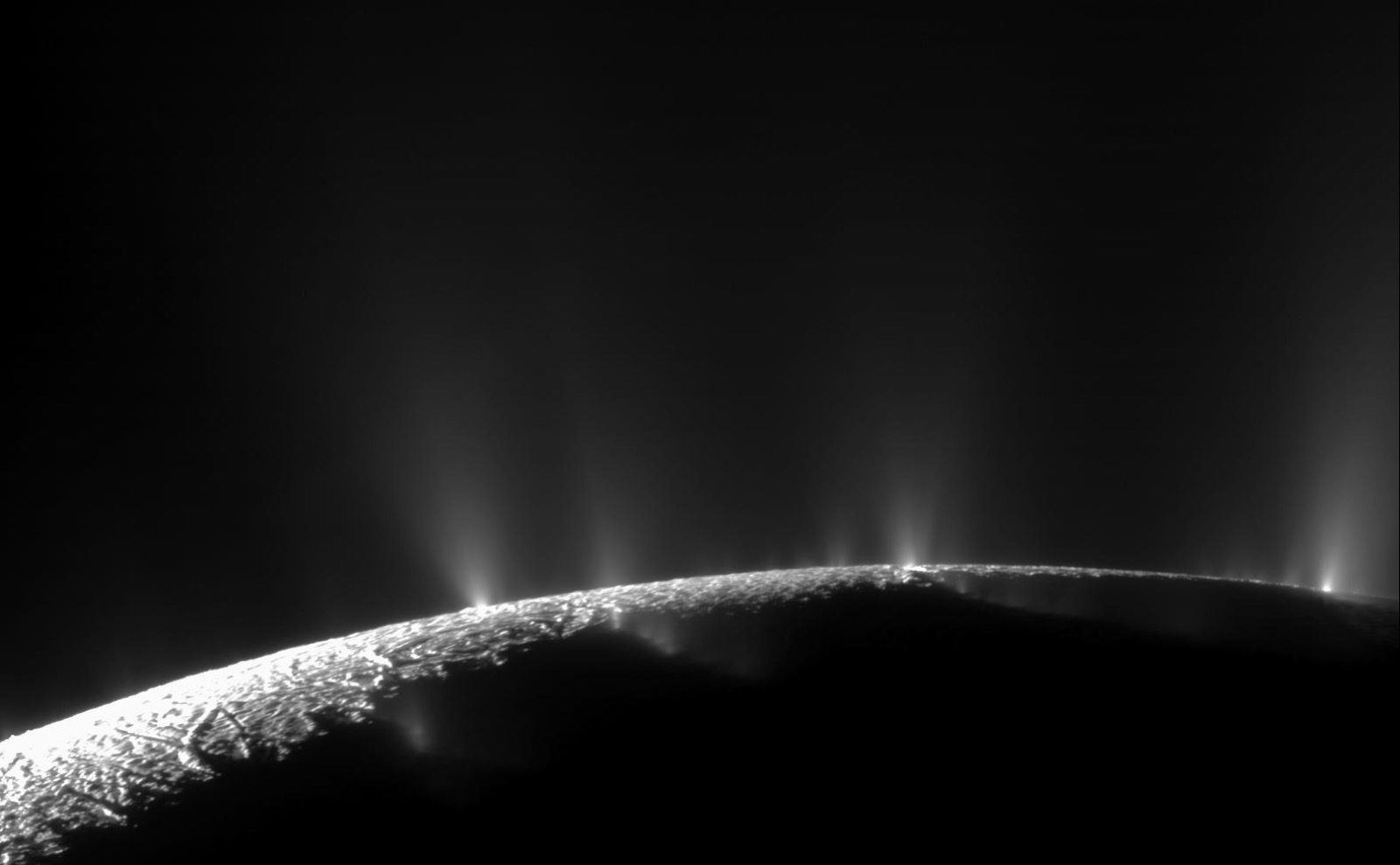
Enceladus backlit, plumes fanning off the south pole. Cassini, NASA/JPL-Caltech (public domain).
So Cassini did the obvious thing. It flew through the plume and tasted it.
- 2015: tiny grains of silica in the plume. Producing them requires water hotter than about 90°C in contact with rock. That means hydrothermal activity on the seafloor of an ice moon.
- 2017: molecular hydrogen, in quantity. The same signature Russell’s vents produce, coming out of a moon 1.2 billion kilometres away.
- 2023: re-analysis of archived plume data turned up hydrogen cyanide, one of the more useful starting molecules in origin-of-life chemistry.
Enceladus appears to be running the same reaction, right now, and spraying samples of it into space for free.
Why this matters, and what it doesn’t say
The honest caveat first, because it’s the whole difference between science and a headline. None of this is life. It’s ingredients and a power source. Russell’s alkaline-vent theory is also not the only contender: there’s a serious rival that starts life in shallow ponds driven by UV light and lightning, which better explains some of the chemistry. That argument is not settled.
But here’s what got me. The reason we can’t check Earth’s origin is that our planet is geologically alive, and it erased the record. Enceladus is small and cold and doesn’t have plate tectonics. It’s not a good copy of early Earth, but it may be a preserved one, and it hands out samples without anyone needing to land or drill.
The chemistry Earth erased might still be out there to check. Just not on Earth.
I find that both humbling and oddly cheerful. We lost our own origin story to something as mundane as rock recycling, and there may be a backup, in orbit around Saturn, that a spacecraft can fly through at 30,000 kilometres an hour and read.
If you liked the “checked against an independent clock” logic here, it’s the same test that runs through an earlier Synapse on geomythology, where the clocks were tree rings and Japanese tsunami records.
Sources
- Cassini’s detection of molecular hydrogen in the plume, and what it implies for habitability: Southwest Research Institute.
- The 2023 identification of hydrogen cyanide and other organics in archived plume data: NASA/JPL.
- The Lost City vent field, and how it matched Russell’s 1993 prediction: Woods Hole Oceanographic Institution.
Part of #MidweekSynapse, my weekly quest to learn in public.
Every Wednesday I pull a thread from my second brain and chase a new idea, usually where two fields meet. It is my quest to understand a bit more, and wire up a new synapse. Read the rest of the series, or follow the 60-second versions at @vinavu_ai.