Midweek Synapse #5
Last week’s post covered the vent chemistry that may have started life on Earth, water meeting rock and giving off hydrogen, and the case that the same reaction is running today inside Enceladus’s ocean. That leaves a few threads worth pulling. No magnetic field, no atmosphere: what protects anything down there? No sunlight: what could possibly eat? And if the chemistry really is running, how long has it even had? The first two turn out to have clean answers. The third doesn’t resolve nearly as neatly.
No field, no air, no problem
Enceladus has no magnetic field of its own. What Cassini’s magnetometer picked up near it in 2005, across three flybys in February, March, and July, was Saturn’s own field bending around the moon, the same signature you would expect from a comet, not evidence of anything Enceladus generates internally. Its atmosphere tells the same story: thin, transient, sourced entirely by the plume itself, and dominated by water vapor at somewhere between 90 and 98 percent depending on which flyby you read, with carbon dioxide, methane, and ammonia making up the rest.
None of that ends up mattering, because the candidate habitat isn’t the surface. It’s an ocean sealed under an ice shell that runs tens of kilometers thick over most of the moon, thinning to somewhere in the range of two to six kilometers at the south pole, where the vents are. The ice is the shield. The ocean never sees space, so it never needed a magnetosphere or an atmosphere to protect it in the first place.
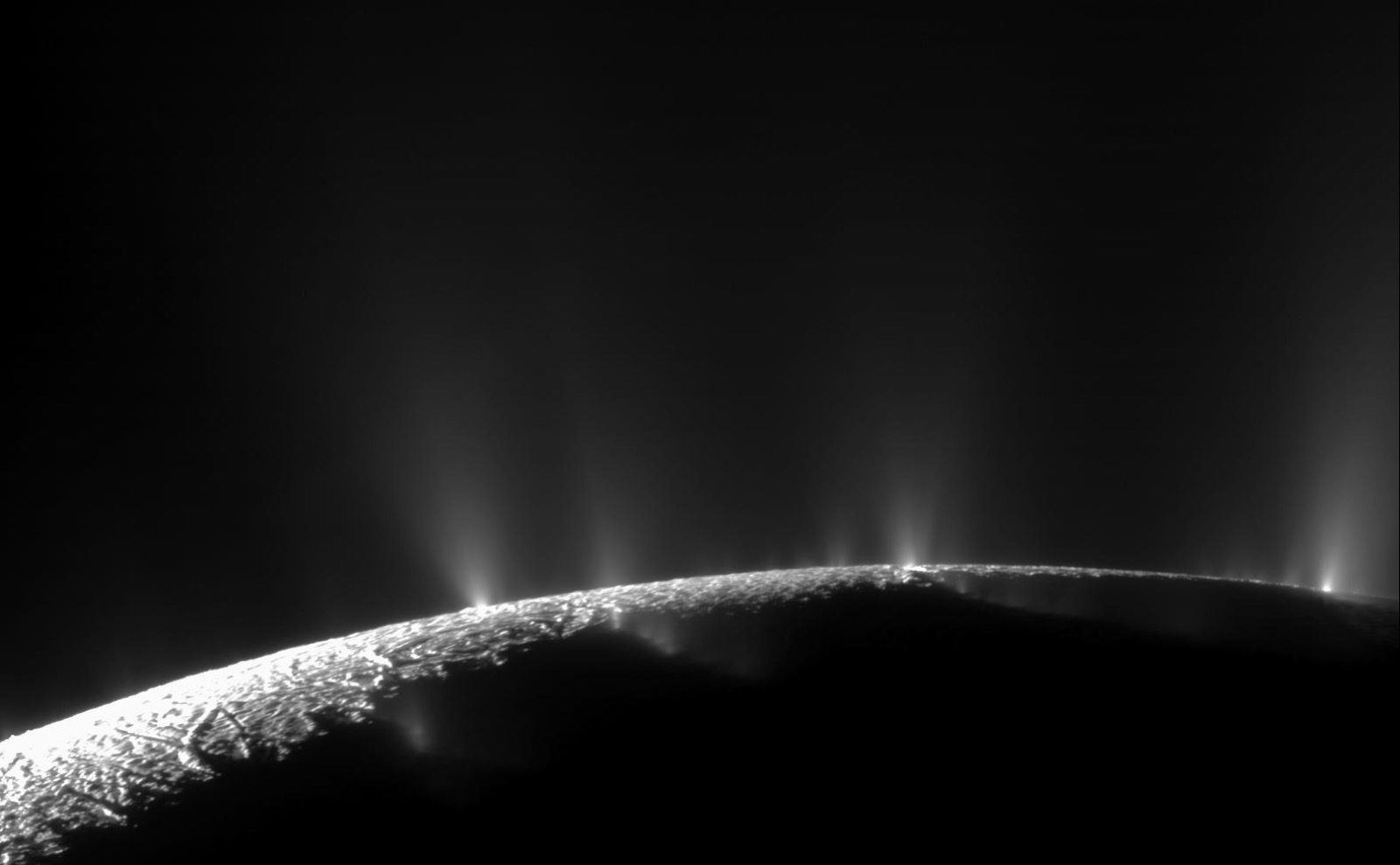
Cassini’s backlit view of Enceladus venting its south pole. The plume is the only part of the moon that reaches space; the ocean underneath stays sealed. NASA/JPL-Caltech.
The dark doesn’t cap complexity
Sunlight drives almost everything Earth’s surface eats, so it’s a fair intuition that no sunlight means no food chain. Earth already contradicts it. Hydrothermal vent ecosystems on the ocean floor run entirely on chemosynthesis, chemical energy pulled from reactions like serpentinization, in total darkness under kilometers of water. They support tube worms, crabs, shrimp, fish, complex multicellular animals, not a thin film of microbes scraping by. It’s a working system, already discovered once at the bottom of an ocean we already had.
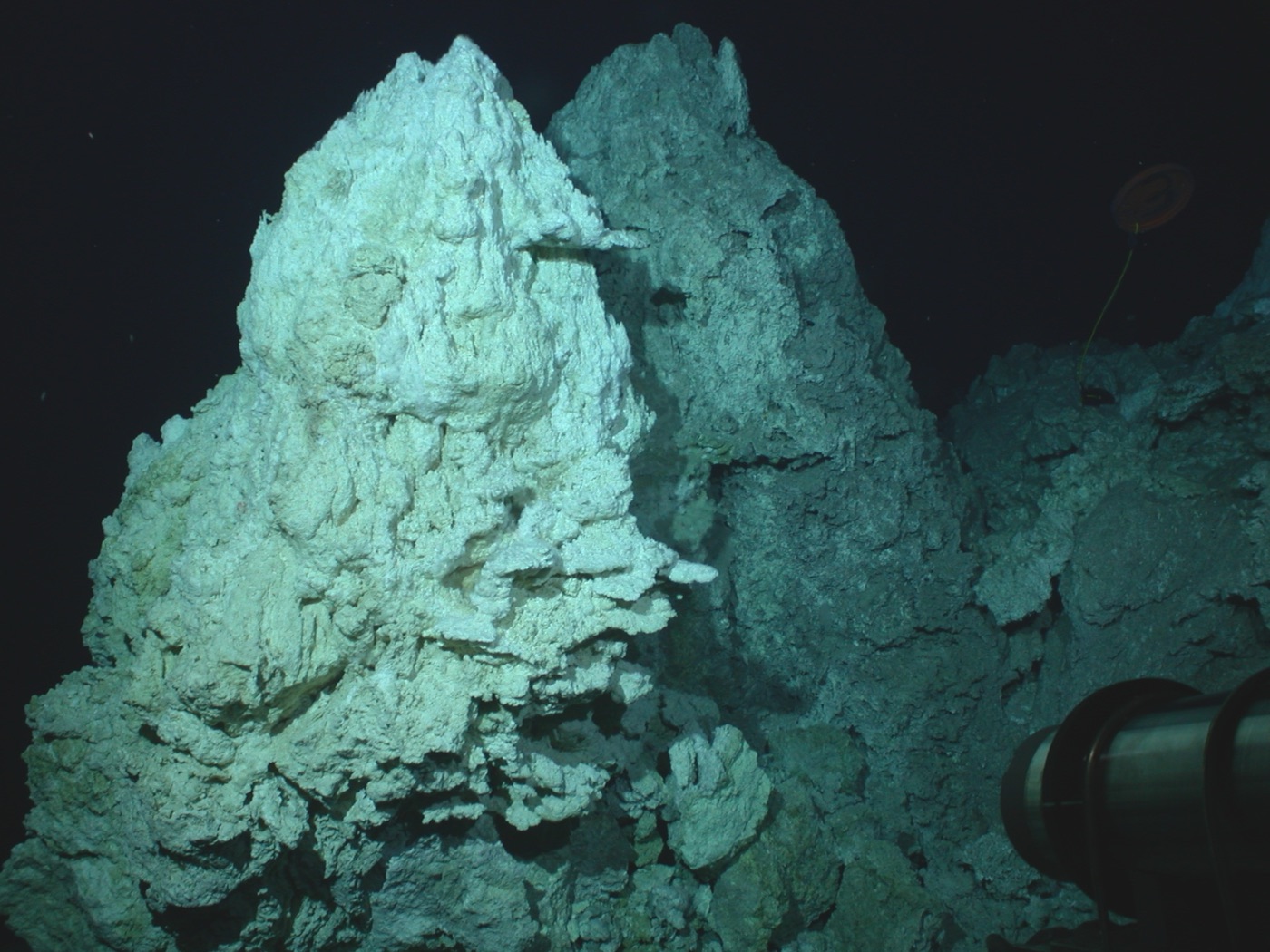
Lost City’s carbonate chimneys, one of Earth’s own examples of complex chemistry running without a photon in sight. NOAA Photo Library.
The part that doesn’t resolve
The first two questions dissolve the same way: something assumed necessary turns out to be one option among several, and a different mechanism at a different scale does the job instead. The third question is different in kind. It isn’t about what Enceladus needs. It’s about how long it’s had.
Estimates for the age of Enceladus’s ocean disagree by roughly a factor of ten. On the young end, dynamical modeling of how Saturn’s inner moons drifted into their current orbits suggests Enceladus itself, geysers and all, may have formed within only the last hundred million years or so, younger than Earth’s Cretaceous period. On the older end, simulations of the ocean’s chemistry, run fifty different ways and checked against what Cassini actually measured, found the best match at an ocean around a billion years old. A separate line of modeling looked at the mechanism keeping the ocean liquid at all: a porous, rocky core kneaded by tidal friction, generating enough heat to sustain the ocean for billions of years, as opposed to the roughly thirty million years it would take to freeze solid without that heat source. Depending on which model is right, Enceladus’s ocean is somewhere between younger than the dinosaurs and older than most complex life on Earth.
That range matters because Earth is the only place we have a timeline for. The first microbial life shows up in the rock record around 3.5 billion years ago, not long after Earth cooled enough to hold liquid water. The first complex, multicellular animals don’t show up for another roughly 2.9 billion years after that. Even the older estimate for Enceladus’s ocean, a billion years, is short of how long Earth’s own first life took just to get started, let alone the far longer stretch it then took to turn into anything with a body plan. On the younger estimate, a hundred million years, there may not have been time for chemistry to become biology at all, though a separate strand of research on how fast abiogenesis itself can happen in principle suggests that particular step might not be the bottleneck it looks like from Earth’s own history.
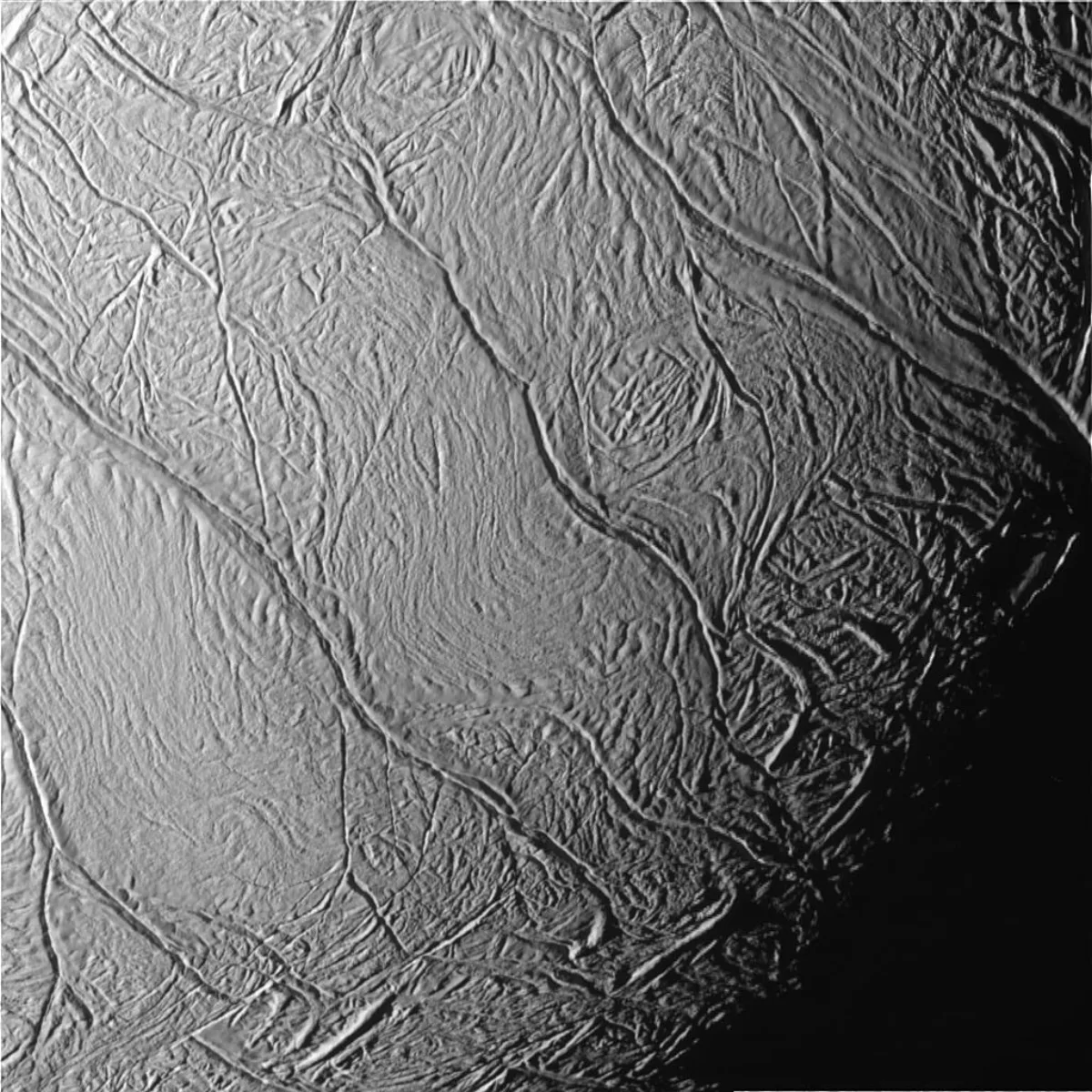
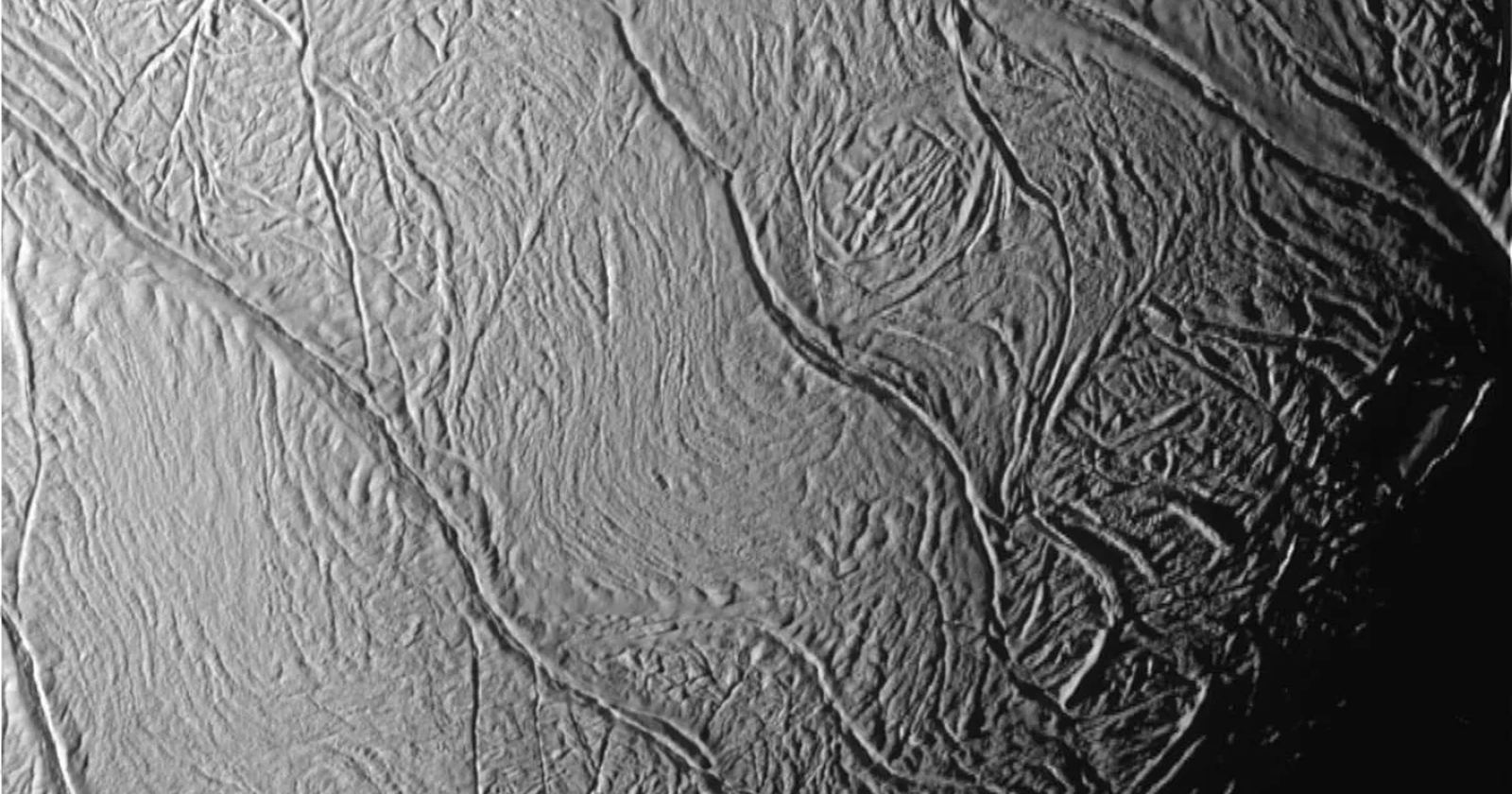
The south polar “tiger stripes,” the active fractures the plumes vent through. How old this terrain actually is, is still being argued over. NASA/JPL-Caltech.
Nobody has published an estimate for how long complex life would take to appear on Enceladus specifically, and that’s not really a gap in the research, it’s an honest reflection of the fact that Earth is a sample size of one. What is genuinely being argued over, in the peer-reviewed literature, is how old the ocean even is, and that number alone is enough to swing the answer from “barely enough time for chemistry” to “plausibly enough time for something,” without ever settling on which.
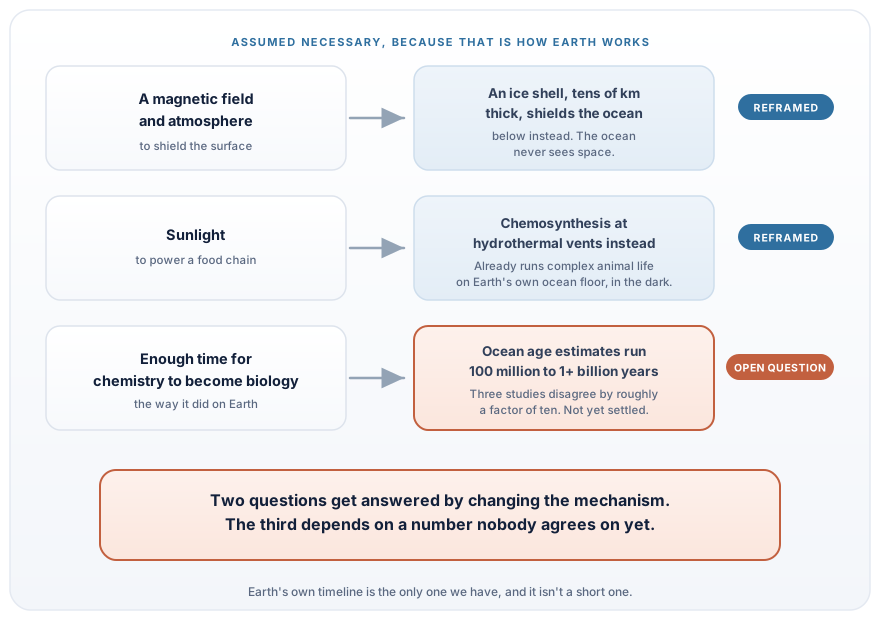
Two get reframed. The third is still waiting on a number nobody agrees on.
Two answers, one open thread
Two of these three questions get answered by moving the requirement to a different mechanism: an ice shell instead of a magnetic field, chemosynthesis instead of sunlight. The third one doesn’t move to a tidy answer, because the number it depends on, the ocean’s age, isn’t settled yet. That’s not a weakness in the argument. It’s the part still worth following, the next time new gravity or libration data comes in and someone narrows the range.
If you liked the “check the intuition against a mechanism Earth already runs” move here, it’s the same test that ran through last week’s Synapse on that same ice shell, where the question was how life might start rather than whether it could survive.
Sources
- The 2005 Cassini magnetometer flybys and the induced, comet-like magnetosphere at Enceladus: NASA/JPL, “The Moon with the Plume”.
- Enceladus plume composition, roughly 98 percent water vapor with hydrogen, carbon dioxide, methane, and ammonia: NASA/JPL, “Enceladus Hydrothermal Activity”.
- Ice shell thickness constrained from Cassini gravity, shape, and libration data: Čadek et al., 2016, Geophysical Research Letters.
- The young-moon estimate, Enceladus and Saturn’s other inner moons possibly under 100 million years old: Ćuk, Dones & Nesvorný, 2016, The Astrophysical Journal.
- The roughly one-billion-year ocean-chemistry estimate: Neveu et al., 2019, “Evolution of Saturn’s mid-sized moons,” Nature Astronomy.
- The porous-core tidal heating model sustaining the ocean for billions of years, versus a roughly thirty-million-year freeze-out without it: Choblet et al., 2017, “Powering prolonged hydrothermal activity inside Enceladus,” Nature Astronomy.
- Earth’s own timeline, first microbial life and first complex multicellular animals: NASA Astrobiology, “How Did Multicellular Life Evolve?”.
Part of #MidweekSynapse, my weekly quest to learn in public.
Every Wednesday I pull a thread from my second brain and chase a new idea, usually where two fields meet. It is my quest to understand a bit more, and wire up a new synapse. Read the rest of the series, or follow the 60-second versions at @vinavu_ai.